The Blind Men and the Algorithm: Making Sense of AI Job Disruption
Jon Green • Published on Sep 23, 2026
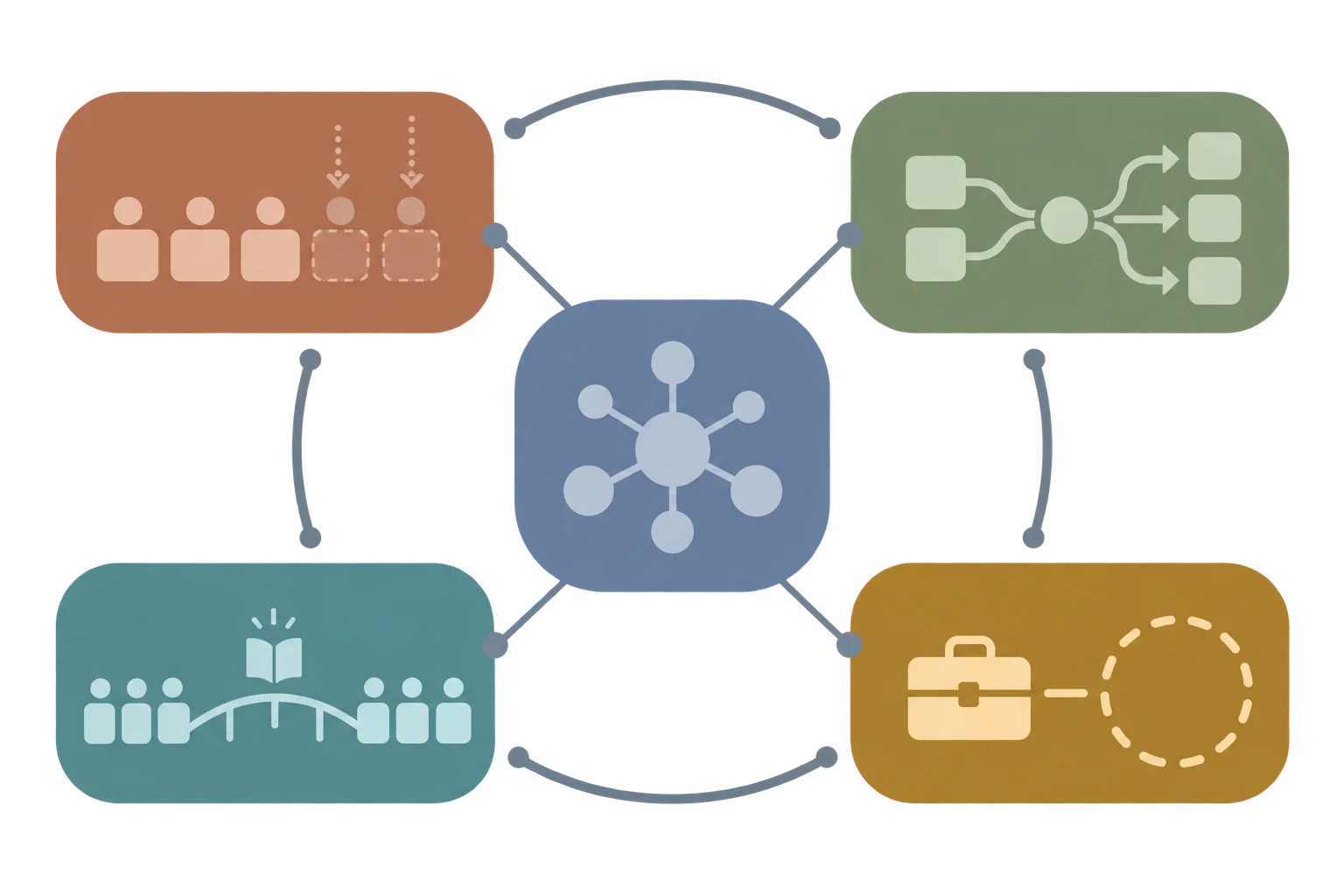
Listen to the most prominent voices in technology, and it sounds like they are watching entirely different futures unfold.
To Dario Amodei, the shock comes fast: AI could eliminate half of all entry-level white-collar jobs and drive unemployment to 10–20 percent within one to five years.[1] Mark Zuckerberg predicted in early 2025 that the technology would be doing the work of a mid-level software engineer before the year was out.[2] Elon Musk stretches the horizon further, but into stranger territory: within 10 to 20 years, Fortune reported, work itself will become “optional.”[3]
Yet other leaders foresee a transition far gentler, or at least familiar. Jensen Huang insists that you will not lose your job to AI, but to someone who uses it.[4] Sundar Pichai argues that AI will “evolve and transition certain jobs,” even as he concedes that some roles will vanish and that society “will have to work through societal disruption.”[5]
Others worry about the immediate friction of the change. Brian Chesky has urged companies not to abandon early-career hiring simply because AI can perform intern-level work, warning that an organization without young recruits today will have no one left to promote into leadership tomorrow.[6] And Jamie Dimon argues that the time to prepare for displacement is already here, calling for government incentives to reward retraining and benefits to support the workers harmed in the process.[7][8]
Like the blind men feeling different parts of an elephant, these leaders are describing pieces of the same system: the labor market under technological change.
How Automation Shifts Labor Demand
In the task-based framework developed most fully by Nobel laureate Daron Acemoglu and Pascual Restrepo, a job is a bundle of tasks, and technology changes which tasks people do.[9] It does so through three forces:
- Displacement. Machines take over tasks people used to do, cutting demand for human labor in those tasks.
- Productivity. Automation lowers costs and expands output, raising demand for workers in the tasks machines cannot do and wherever the savings get spent.
- Reinstatement. Innovation creates new tasks in which people have the advantage, pulling demand for workers back up.
Employment is the net result of the three, with no guaranteed happy ending. Acemoglu and Restrepo found that for about four decades after World War II, new tasks arrived fast enough to roughly balance automation. Since 1987, displacement has accelerated while reinstatement has weakened and productivity growth has slowed, a shift they argue helps explain three decades of sluggish job growth.[9]
Viewed against that baseline, technology executives are simply wagering on different variables. Amodei and Zuckerberg anticipate rapid and extensive displacement. Musk’s scenario requires reinstatement to fail almost entirely, and economists take that possibility seriously: Anton Korinek and Donghyun Suh have modeled scenarios in which automation eventually reaches every task humans can do, and wages collapse as a result.[10] Huang and Pichai bet that productivity and reinstatement will generate enough altered work to absorb the displaced. Chesky sees displacement biting specifically at the junior tier. Dimon identifies the painful mismatch when displaced workers cannot move smoothly into newly created tasks.
The Lag in the Numbers
Timing complicates the debate. Steam, electricity, and computers belong to the category of “general purpose technologies”: innovations that spread throughout an economy, advance over decades, and generate complementary inventions.[11] There is a strong case that large language models fit that mold.[12]
Yet general purpose technologies carry an inherent delay. Capturing their value demands unmeasured, slow investments: restructuring workflows, retraining personnel, reshaping management, and building new business models. Erik Brynjolfsson, Daniel Rock, and Chad Syverson demonstrated that these hidden investments produce a J-curve in measured productivity. At first the line stays flat or sags while firms commit real resources to organizational restructuring that official metrics omit; the surge arrives only after those complementary changes take root.[13]
Displacement acts without this delay. A software process replaces a task, and a hiring budget evaporates in an afternoon. But the productivity effect that spurs secondary labor demand stays stuck in the flat part of the J-curve while organizations retool.
What Past Transitions Reveal
Electricity
Thomas Edison’s first central power station opened in 1882, but Paul David showed that electricity’s big productivity payoff in American manufacturing did not arrive until the 1920s.[14] For decades, manufacturers merely swapped out centralized steam engines for electric motors while preserving old layouts of belts and overhead driveshafts. The gains materialized only after factories discarded old architectures, placing individual electric motors on every machine, shifting onto single-floor layouts, and configuring the factory floor around the natural sequence of work. The wait lasted roughly forty years.
Computers
In 1987, Robert Solow captured the same lag: “You can see the computer age everywhere but in the productivity statistics.”[15] The payoff appeared in the late 1990s, driven by information technology.[16] As with electrification, the largest returns accrued to businesses that reorganized how they worked.[17]
The shift altered who worked. Computers took over routine clerical and production tasks while raising demand for analytical and interpersonal work.[18] New tasks multiplied, but they frequently bypassed the displaced, creating a polarized labor market.[19] Over long periods, the birth of novel work has been profound: roughly 60 percent of American jobs in 2018 existed in categories not yet invented in 1940.[20] Yet those roles arrived unevenly and slowly, and they often went to different people from those who suffered the initial losses.
The State of the Transition in 2026
Not Yet in the Aggregate Numbers
In July 2026, Federal Reserve economists evaluated indicators covering AI capabilities, investment, adoption, productivity, and labor markets. They concluded that the evidence was consistent with “a buildout phase rather than the onset of broad-based displacement.”[21] They noted that a 10 percent efficiency gain on an isolated task fails to generate a 10 percent gain for an entire firm when secondary bottlenecks constrain output.[21] Accelerating code drafting, for example, merely shifts the logjam to testing, review, or integration.
Task-level studies reflect this divergence. In one large study of customer-support representatives, a generative AI tool boosted productivity by 14 percent overall and by 34 percent for novices.[22] Yet in a randomized trial, experienced open-source developers relying on early-2025 AI tools took 19 percent longer to complete assignments, despite believing the software had made them faster.[23]
Taking the task-level evidence at face value, Acemoglu calculates that AI will increase total factor productivity by no more than about 0.66 percent over a decade, and probably less.[24] Researchers studying the J-curve expect larger returns once complementary organizational investments mature, but those returns remain prospective.
Entry-Level Contraction
The economy-wide adoption numbers tell a measured story. A representative U.S. Census Bureau survey from November 2025 through January 2026 found that only 18 percent of firms used AI in any business function, with most users confining it to three or fewer.[25] Among firms reporting task-level changes from AI, 66 percent said it only augmented existing work, while complete task substitution remained rare, and direct headcount effects were minimal and roughly balanced between firms adding jobs and those cutting them.[25] Yet among the subset replacing tasks, the proportion replacing “a large number” of tasks climbed from 2.5 percent to 7 percent since 2024.[25]
Where displacement strikes, it strikes unevenly. Payroll records analyzed by Stanford’s Digital Economy Lab through June 2026 found no evidence of economy-wide displacement, but employment among workers aged 22 to 25 in the most AI-exposed roles fell roughly 19 percent below where it would have been had it tracked peers in less exposed fields.[26] Experienced workers in the same occupations showed no comparable gap, and the adjustment came mainly through reduced hiring rather than layoffs.[26]
Early-Career Employment Fell in AI-Exposed Jobs as Others Grew
Approximate change in employment, November 2022 to June 2026
Show the data behind this chart
| Group | Change in employment, Nov 2022 to Jun 2026 |
|---|---|
| Ages 22–25, most exposed jobs (top two of five AI-exposure groups) | about −11% |
| Ages 22–25, least exposed jobs (bottom three groups) | about +10% |
| All workers in sample | about +6% |
Source: Brynjolfsson, Chandar and Chen, Stanford Digital Economy Lab, ADP payroll data.[26]
The Stanford researchers offer an explanation: younger employees rely on codified, “book” knowledge that generative models replicate with ease, while experienced staff rely more on tacit knowledge built up on the job, which AI struggles to replicate.[26] The authors caution that these patterns are descriptive rather than proof that AI caused them, but the mechanism is easy to picture. Take a team of five experienced employees who, with AI, absorb the workload that once required those five plus two junior hires. No one is laid off. The junior postings simply never go up.
New Tasks, Mostly for the Experienced
Software engineering reveals these dynamics in real time. Initial AI programming tools automated isolated tasks: autocomplete, test generation, documentation, and debugging. Increasingly, the developer’s role is shifting toward specifying problems, providing context, delegating work to AI systems, and reviewing the results.
When writing code becomes cheap, the scarce skills become understanding the organization, connecting systems, securing trustworthy data, defining requirements, evaluating output, and deciding what to build in the first place. The tooling is moving the same way. Retrieval-augmented generation, which connects language models to an organization’s own documents and data, has become standard enough that Gartner publishes a reference architecture for it.[27] Microsoft and Google Research both published work in 2026 on “agentic” retrieval, shifting models from passive query response to active navigation and reasoning across enterprise repositories.[28][29]
The open question is whether these new tasks can employ as many people as the ones they replace, and whether they can absorb junior candidates who have not yet built up tacit judgment. For now, the entry-level data suggests they favor experienced workers.
Physical Capital Demands
The upfront costs of the J-curve are not just organizational; they are concrete and physical. In September 2026, Reuters reported that AI server demand had sparked a worldwide memory crunch that industry leaders project will persist through at least 2027, with TrendForce noting that manufacturers prioritized capital spending on DRAM and high-bandwidth memory for AI, limiting new NAND flash capacity.[30] AI data center buildouts generated shortages in high-capacity enterprise storage, driving record revenue for the top enterprise storage suppliers.[31] Smaller phone and laptop makers have responded by redesigning products, testing incoming chips for counterfeits, and passing costs on to customers.[32]
Capital allocation, chip manufacturing, data-center construction, and energy demand are reorganizing around the technology before its productivity payoff shows up in the statistics.
Observing the Trajectory
The differing views among technology leaders come down to specific, observable trends.
If Huang and Pichai are correct that reinstatement and productivity will dominate, we will see task classifications expand, AI-related job additions outpace reductions in Census updates, and the 19 percent employment gap among young workers stabilize or close.
If Amodei, Zuckerberg, and Musk are correct that displacement will overwhelm new task creation, the employment gap will creep from early-career roles into mid-career cohorts, the share of firms replacing “a large number” of tasks will keep climbing past 7 percent, and absolute job declines will spread beyond exposed occupations.
If Solow’s productivity paradox is simply repeating itself along the J-curve, aggregate productivity will accelerate while employment holds firm, as it did in the late 1990s. If Chesky and Dimon are right that transition friction dominates, senior employment will expand while junior hiring stagnates, confirming that the benefits of the technology and its displacement costs are falling on different people.
The historical record suggests that economies eventually generate new tasks to replace what automation dissolves. But that realignment is neither automatic nor rapid, and it offers little guarantee to the workers standing at the point of transition.
References
- Axios. “AI Jobs Danger: Sleepwalking into a White-Collar Bloodbath.” May 28, 2025. https://www.axios.com/2025/05/28/ai-jobs-white-collar-unemployment-anthropic
- IT Pro. “A Sign of Things to Come in Software Development? Mark Zuckerberg Says AI Will Be Doing the Work of Mid-Level Engineers This Year.” January 2025. Reporting Zuckerberg’s January 2025 interview on The Joe Rogan Experience. https://www.itpro.com/software/development/a-sign-of-things-to-come-in-software-development-mark-zuckerberg-says-ai-will-be-doing-the-work-of-mid-level-engineers-this-year-and-hes-not-the-only-big-tech-exec-predicting-the-end-of-the-profession
- Fortune. “Elon Musk Says That in 10 to 20 Years, Work Will Be Optional and Money Will Be Irrelevant Thanks to AI and Robotics.” November 20, 2025. https://fortune.com/2025/11/20/elon-musk-tesla-ai-work-optional-money-irrelevant/
- CNBC. “Nvidia CEO Jensen Huang: You’ll ‘Lose Your Job to Somebody Who Uses AI.’” May 28, 2025. https://www.cnbc.com/2025/05/28/nvidia-ceo-jensen-huang-youll-lose-your-job-to-somebody-who-uses-ai.html
- Fortune. “As AI Wipes Jobs, Google CEO Sundar Pichai Says It’s Up to Everyday People to Adapt Accordingly: ‘We Will Have to Work Through Societal Disruption.’” December 2, 2025. https://fortune.com/2025/12/02/ai-wipes-jobs-google-ceo-sundar-pichai-everyday-people-to-adapt-accordingly-we-have-to-work-through-societal-disruption
- CNBC. “Airbnb CEO Brian Chesky’s Advice for College Students in the Age of AI.” October 29, 2025. https://www.cnbc.com/2025/10/29/airbnb-ceo-brian-cheskys-advice-for-college-students-in-the-age-of-ai.html
- Fortune. “Jamie Dimon Says Society Should Start Preparing for AI Job Displacement: ‘Now’s the Time to Start Thinking About’ It.” February 25, 2026. https://finance.yahoo.com/news/jamie-dimon-says-society-start-183905082.html
- CNBC. “Dimon Warns on AI Job Losses, Calls for Government-Business Incentives.” March 24, 2026. https://www.cnbc.com/2026/03/24/jamie-dimon-ai-job-loss.html
- Acemoglu, Daron, and Pascual Restrepo. “Automation and New Tasks: How Technology Displaces and Reinstates Labor.” Journal of Economic Perspectives 33, no. 2 (2019): 3–30.
- Korinek, Anton, and Donghyun Suh. “Scenarios for the Transition to AGI.” NBER Working Paper 32255, 2024.
- Bresnahan, Timothy F., and Manuel Trajtenberg. “General Purpose Technologies ‘Engines of Growth’?” Journal of Econometrics 65, no. 1 (1995): 83–108.
- Eloundou, Tyna, Sam Manning, Pamela Mishkin, and Daniel Rock. “GPTs Are GPTs: Labor Market Impact Potential of LLMs.” Science 384, no. 6702 (2024): 1306–1308.
- Brynjolfsson, Erik, Daniel Rock, and Chad Syverson. “The Productivity J-Curve: How Intangibles Complement General Purpose Technologies.” American Economic Journal: Macroeconomics 13, no. 1 (2021): 333–372.
- David, Paul A. “The Dynamo and the Computer: An Historical Perspective on the Modern Productivity Paradox.” American Economic Review 80, no. 2 (1990): 355–361.
- Solow, Robert M. “We’d Better Watch Out.” New York Times Book Review, July 12, 1987.
- Oliner, Stephen D., and Daniel E. Sichel. “The Resurgence of Growth in the Late 1990s: Is Information Technology the Story?” Journal of Economic Perspectives 14, no. 4 (2000): 3–22.
- Bresnahan, Timothy F., Erik Brynjolfsson, and Lorin M. Hitt. “Information Technology, Workplace Organization, and the Demand for Skilled Labor: Firm-Level Evidence.” Quarterly Journal of Economics 117, no. 1 (2002): 339–376.
- Autor, David H., Frank Levy, and Richard J. Murnane. “The Skill Content of Recent Technological Change: An Empirical Exploration.” Quarterly Journal of Economics 118, no. 4 (2003): 1279–1333.
- Autor, David H. “Why Are There Still So Many Jobs? The History and Future of Workplace Automation.” Journal of Economic Perspectives 29, no. 3 (2015): 3–30.
- Autor, David, Caroline Chin, Anna Salomons, and Bryan Seegmiller. “New Frontiers: The Origins and Content of New Work, 1940–2018.” Quarterly Journal of Economics 139, no. 3 (2024): 1399–1465.
- Soto, Paul E., Mason Thieu, and Jeffrey S. Allen. “The AI Buildout and the Economy: Publicly Available Data to Assess AI’s Impact.” FEDS Notes, Board of Governors of the Federal Reserve System, July 17, 2026. https://www.federalreserve.gov/econres/notes/feds-notes/the-ai-buildout-and-the-economy-publicly-available-data-to-assess-ais-impact-20260717.html
- Brynjolfsson, Erik, Danielle Li, and Lindsey Raymond. “Generative AI at Work.” Quarterly Journal of Economics 140, no. 2 (2025): 889–942.
- Becker, Joel, Nate Rush, Elizabeth Barnes, and David Rein. “Measuring the Impact of Early-2025 AI on Experienced Open-Source Developer Productivity.” METR, arXiv:2507.09089, 2025.
- Acemoglu, Daron. “The Simple Macroeconomics of AI.” Economic Policy 40, no. 121 (2025). Earlier version: NBER Working Paper 32487, 2024.
- Bonney, Kathryn, et al. “The Microstructure of AI Diffusion: Evidence from Firms, Business Functions, and Worker Tasks.” U.S. Census Bureau, CES Working Paper 26-25, April 2026. Also NBER Working Paper 35141. https://www.census.gov/library/working-papers/2026/adrm/CES-WP-26-25.html
- Brynjolfsson, Erik, Bharat Chandar, and Ruyu Chen. “Canaries in the Coal Mine? Six Facts about the Recent Employment Effects of Artificial Intelligence.” Stanford Digital Economy Lab, revised August 12, 2026. https://digitaleconomy.stanford.edu/news/canariesaug26/
- Agarwal, Sumit. “Reference Architecture Brief: Retrieval-Augmented Generation.” Gartner, 2026. https://www.gartner.com/en/documents/5826347
- Suresh, Susheel, et al. “AgenticRAG: Agentic Retrieval for Enterprise Knowledge Bases.” Microsoft, May 2026. arXiv:2605.05538.
- Rashtchian, Cyrus, and Da-Cheng Juan. “Unlocking Dependable Responses with Gemini Enterprise Agent Platform’s Agentic RAG.” Google Research, June 2026. https://research.google/blog/unlocking-dependable-responses-with-gemini-enterprise-agent-platforms-agentic-rag/
- Reuters. “China’s CXMT Eyes Flash-Memory Push amid Global Shortage; Firm to Take on Samsung, YMTC.” September 18, 2026.
- TrendForce. “AI Agent Boom Triggers Enterprise SSD Supply Crunch; Top Five Enterprise SSD Brands Post Record US$18.46 Billion Revenue in 1Q26.” June 11, 2026. https://www.trendforce.com/presscenter/news/20260611-13092.html
- Reuters. “Smaller Phone and Laptop Makers Dig In for Years of Memory Scarcity.” September 16, 2026.