Serving Markdown to AI Agents: 73% Fewer Tokens, Same Content
Jon Green • Published on Aug 31, 2026
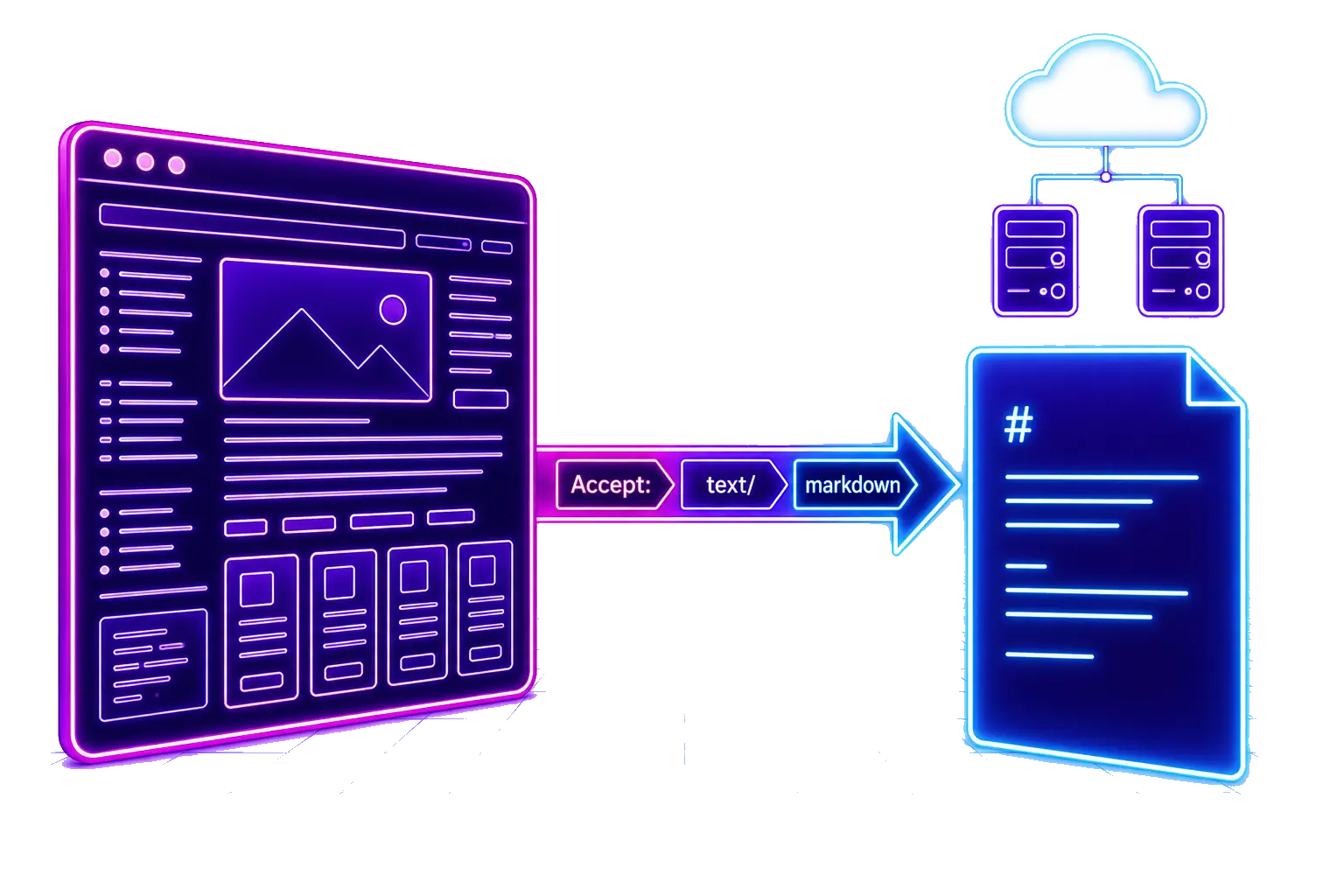
When an AI agent reads an article here, it downloads the nav, the footer, the meta tags and every Tailwind class. The words are a minority of the payload.
| Bytes | ~Tokens | |
|---|---|---|
| Rendered HTML | 30,010 | ~7,502 |
| Markdown | 7,975 | ~1,993 |
73% smaller. Cloudflare measured 80% doing this at their edge; Checkly measured 99.7% on a markup-heavy docs page.
Three parts: an Astro endpoint emitting .md alongside every page, an llms.txt advertising them, and a CloudFront Function serving Markdown to anything sending Accept: text/markdown. All code below is what runs in production.
First, the trap
Detecting AI crawlers by User-Agent and serving them something different is cloaking — one of the few practices triggering both algorithmic demotion and a site-level manual penalty from Google. It also backfires: if OpenAI or Anthropic notice the fetched content doesn’t match what a human sees, the rational response is to stop citing you.
My first draft had a crawler list containing googlebot, bingbot and msnbot, rewriting them to a JSON bundle. Shipped, it would have served Google a blob of JSON instead of my website.
The distinction:
- Different content per agent → cloaking.
- Same content, different format, chosen by the client → content negotiation.
Never branch on who is asking. Branch only on what they asked for. Everything below follows that rule, so search engines see byte-identical HTML.
Part 1: Emit Markdown from Astro
Content collections already hold the raw body as entry.body, so the endpoint is mostly formatting.
// src/pages/entries/[slug]/index.md.ts
import type { APIRoute } from "astro";
import { getCollection } from "astro:content";

export const prerender = true;

export async function getStaticPaths() {
  const entries = await getCollection("entries", (e) => !e.data.draft);
  return entries.map((entry) => ({
    params: { slug: entry.id },
    props: { entry },
  }));
}

export const GET: APIRoute = ({ props, site }) => {
  const { entry } = props;

  const document = [
    `# ${entry.data.title}`,
    "",
    `> ${entry.data.description}`,
    "",
    `Published: ${entry.data.pubDate.toISOString().slice(0, 10)}`,
    `Source: ${site}entries/${entry.id}`,
    "",
    "---",
    "",
    entry.body.trim(),
    "",
  ].join("\n");

  return new Response(document, {
    headers: { "content-type": "text/markdown; charset=utf-8" },
  });
};
Sits next to your existing [slug].astro without conflict. The build emits both index.html and index.md.
Three details that matter:
- Include the canonical URL. The file is read with no surrounding page. Without it an agent can quote you but not cite you — and the citation is the whole return.
- Pass the body through untouched. No summarizing. The moment the Markdown says something the HTML doesn’t, you’re cloaking again.
sitealready ends in a slash, so it’s${site}entries/…, not${site}/entries/….
Part 2: Advertise with llms.txt
// src/pages/llms.txt.ts
import type { APIRoute } from "astro";
import { getCollection } from "astro:content";

export const prerender = true;

export const GET: APIRoute = async ({ site }) => {
  const entries = await getCollection("entries", (e) => !e.data.draft);

  const lines = [
    "# Your Site Name",
    "",
    "> One-line description of the site.",
    "",
    "## Posts",
    "",
    ...entries.map(
      (e) => `- [${e.data.title}](${site}entries/${e.id}/index.md): ${e.data.description}`,
    ),
  ];

  return new Response(lines.join("\n") + "\n", {
    headers: { "content-type": "text/plain; charset=utf-8" },
  });
};
Point links at the .md files, or it’s a sitemap with extra steps.
Keep expectations low. Adoption is ~8–10%, there’s no W3C or IETF backing, and as of early 2026 no major AI company has committed to reading it — the AI search crawlers it nominally serves mostly crawl HTML instead. Its real audience is IDE agents: Claude Code, Cursor, Copilot, Cline.
Stopping here gives you a complete, zero-risk setup. No infrastructure touched. Part 3 is convenience.
Part 3: Negotiate at the CloudFront edge
This makes Accept: text/markdown work on the canonical URL, so agents needn’t know the .md path exists. Of seven coding agents Checkly tested, three send that header — Claude Code, Cursor, OpenCode. Codex, Copilot, Gemini CLI and Windsurf don’t.
// infra/live/function.js — CloudFront viewer-request function
function handler(event) {
    var request = event.request;
    var uri = request.uri;

    // Guard every access: a TypeError here returns 503 for the request.
    var acceptHeader = request.headers && request.headers['accept'];
    var accept = acceptHeader && acceptHeader.value
        ? acceptHeader.value.toLowerCase()
        : '';

    // Branch on what was ASKED FOR, never on who is asking.
    if (accept.indexOf('text/markdown') !== -1 && uri.indexOf('/entries/') === 0) {
        var slug = uri.slice('/entries/'.length).replace(/\/$/, '');
        // Single path segment only: skips the /entries/ index and any asset.
        if (slug.length > 0 && slug.indexOf('/') === -1 && slug.indexOf('.') === -1) {
            request.uri = '/entries/' + slug + '/index.md';
            return request;
        }
    }

    // Existing clean-URL rewrites.
    if (uri.endsWith('/')) {
        request.uri += 'index.html';
    } else if (uri.indexOf('.') === -1) {
        request.uri += '/index.html';
    }

    return request;
}
Why this doesn’t poison your cache
Rewriting the URI is what keeps the formats separate: viewer-request functions transform request attributes to build the cache key, so /entries/x/index.html and /entries/x/index.md occupy different cache entries. Putting raw Accept in the cache key instead would shatter it — browsers send dozens of variants.
Verify anyway, in this order. The failure is silent: no error, just some visitors receiving raw Markdown.
URL=https://yoursite.com/entries/some-post/

curl -s -o /dev/null -w '%{content_type}\n' "$URL"
curl -s -o /dev/null -w '%{content_type}\n' -H 'Accept: text/markdown' "$URL"
curl -s -o /dev/null -w '%{content_type}\n' "$URL"   # must still be text/html
Testing without breaking your site
This function runs on every request. An unhandled exception returns HTTP 503 — a total outage, not a degraded feature.
AWS will run your function in its real engine:
aws cloudfront test-function \
  --name your-function-name \
  --if-match "$(aws cloudfront describe-function --name your-function-name \
      --stage DEVELOPMENT --query ETag --output text)" \
  --stage DEVELOPMENT \
  --event-object fileb://event.json
{
"version": "1.0",
"context": { "eventType": "viewer-request" },
"viewer": { "ip": "203.0.113.1" },
"request": {
"method": "GET",
"uri": "/entries/some-post/",
"headers": { "accept": { "value": "text/markdown" } },
"cookies": {},
"querystring": {}
}
}It returns the modified request, logs and any error. Loop it over a table of cases and you have a CI gate.
Three things I learned the hard way:
Publishing does not validate the runtime. A function using const is created successfully and only fails when a request hits it:
SyntaxError: Token "const" not supported in this versionIt sits there quietly until the first request, then every request 503s. create-function is not a safety net; test-function is.
The constraint is ES5.1 syntax, not the ES5.1 standard library. Plenty of guidance says avoid String.includes. I probed the real runtime: String.includes, startsWith, Array.includes, Array.some and Object.assign all work. What breaks is const/let, arrow functions and template literals — at parse time, which is why one bad token takes down every route rather than just the new one.
Don’t test against your live function’s DEVELOPMENT stage. If Terraform manages the function, publishing candidate code there makes terraform plan report “No changes” — that’s the stage it compares against — while the LIVE stage serving traffic stays stale. Your gate silently blocks the deploy it was validating. Create a throwaway function, test in it, delete it.
What I skipped
CloudFront continuous deployment. Correct for a business; ceremony for a personal site. Function updates propagate in under a minute, so rollback is republishing, and the worst case is a couple of minutes of downtime.
Bulk JSON/NDJSON bundles. My original plan had /pack.ndjson with per-entry hashes and reading times. I found no evidence anything consumes that shape. A Markdown file per page is where the ecosystem landed.
Worth tracking, not building on
The IETF’s AIPREF working group is doing standards-track work on a vocabulary for AI usage preferences via robots.txt and HTTP headers — the likeliest eventual answer, still a draft. RSL 1.0 covers licensing and royalties for publishers wanting payment for training use (Reddit, Yahoo, Medium, O’Reilly have adopted it). Neither matters if you’re giving the writing away.
While in robots.txt, decide deliberately. AI crawlers split three ways:
| Kind | Examples | Blocking costs you |
|---|---|---|
| Training | GPTBot, ClaudeBot, Google-Extended | nothing in citations |
| Search | OAI-SearchBot, Claude-SearchBot, PerplexityBot | removal from AI answers |
| User-triggered | ChatGPT-User, Claude-User, Perplexity-User | the person asking about you gets nothing |
I allow all three, and wrote the reasoning into the file so future-me knows it was a choice.
An agent sending one header gets my writing for a quarter of the tokens. Everything else — every browser, Googlebot, any crawler that doesn’t ask — gets byte-identical HTML.
A couple of hundred lines, and the only risky part is optional.
Source: github.com/jgreen01/jgreen.one.